
12 Dic Launch of GMMP Global Report 2025 initiates strategic re-think to drive gender equality in the news
With progress towards media gender parity on a plateau, women’s rights advocates are taking time to pause, reflect, and innovate.
Gender equality in the global news media is at a crossroads 30 years after the adoption of the Beijing Platform for Action, the 2025 Global Media Monitoring Report (GMMP) has found.
Following an initial slow and steady rise in women’s share of visibility and voice in the news, progress has flatlined, Sarah Macharia, GMMP Expert Group convenor, told participants at the launch of the Global Report of the 7th edition of the largest and longest-running study on the gender in the world’s media.
Though women make up half of the world’s population, only 26% of the people seen heard or spoken about in print and broadcast news, are women. The story on dedicated news websites is only marginally better, at 29%.
30-year findings
Thirty years ago, governments committed in Section J of the Beijing Platform for Action to transform women’s participation in and through the media and to eliminate harmful gender stereotypes, noted Kalliopi Mingeirou, Chief of the Ending Violence against Women and Girls Section of UN Women, a GMMP programmatic partner since 2010.
Media monitoring was recognized as a key strategy to help drive and inform action. “Since 1995, the [GMMP] has given us the most consistent evidence we have on gender in the news,” Mingeirou said.
Over 80% of the countries in the world, with 97% of the global population, have participated in one or more of the seven GMMP studies.
The data in the special edition GMMP from 2025 show that there has been a mere nine-point increase in women’s presence in the news in those 30 years, Macharia reported – with most of this coming in the first 15 years after Beijing.
The picture for minority women is even more dismal; less than one in 10 women in the news belong to a minority group.
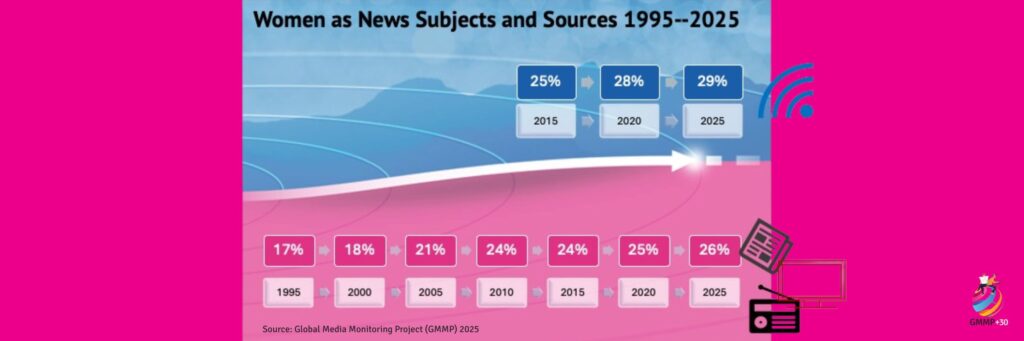
“All four media types have converged and flatlined to a level far short of parity. Once a baseline of visibility was achieved, the motivation for fundamental structural change appears to have dissipated,” she noted.
“Three decades on, the 2025 GMMP shows us how unfinished [Beijing’s] promise remains,” Mingeirou observed. “This report is both a wake-up call and a roadmap.”
Progress on a plateau
The standstill in progress is evident in GMMP data collected on a range of indicators, Macharia said.
The media has normalized the male voice of authority, seen in the expert and spokesperson function, where the gap between men and women has closed at a slower pace than for people providing testimony based on personal experience and popular opinion.
This points to “a system that has learnt to incorporate women’s voices without redistributing authority,” she said.
Macharia noted that the gender gap in reporters in the news is narrower today than when it was first tracked for print and broadcast news, a positive finding particularly given that the representation of women has proven to be higher in news articles by women reporters.
However, change in this area has levelled out since 2005 for traditional media, while the percentage of women reporters online has hovered between 42% and 43% since the GMMP began monitoring digital news in 2015.
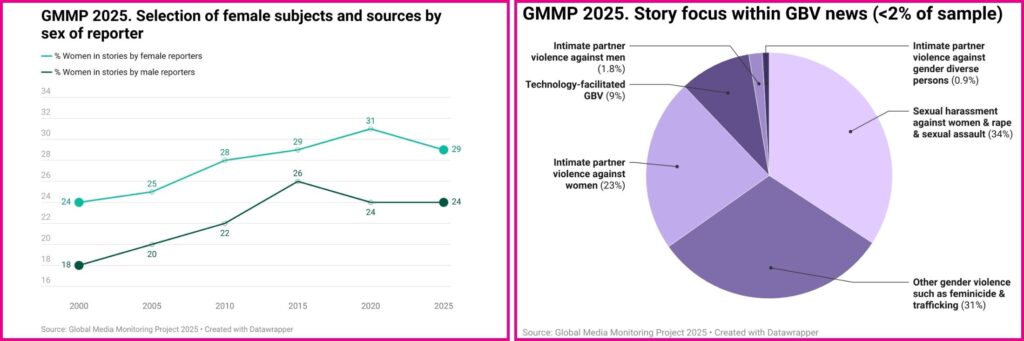
Particularly concerning are the GMMP 2025 findings on coverage of gender-based violence (GBV), Macharia said. Less than 2% of news articles deal with this fundamental violation of human rights that affects one in three women and girls worldwide.
The newly published report shows that media have not made progress either in challenging gender stereotypes. In 20 years of GMMP research into the gender quality of reporting, 6% (in 2010) was the highest proportion of coverage that defies stereotypes. Since 2010, this has stagnated at only three in 100 stories.
There is “a consistent lack of progress by the news media in producing content that disrupts the status quo,” Macharia said.
Reset required
The time has come to pause, reflect, and innovate to break through the persisting inertia, Macharia observed.
“To arrive at a plateau implies that there was progress in the past. The almost standstill pace of change in the last 15 years points to a need for a reset, a radical shift in strategies.”
GMMP 2025
Discover the Findings
Confront structural barriers in newsrooms
This refocusing of efforts to advance gender equality in and through the media must “confront structural and institutional barriers” – starting with those in newsrooms, said Amie Joof-Cole, GMMP West & Central Africa coordinator and national coordinator for the GMMP in Senegal.
This means questioning a range of factors like power structures, gatekeeping, leadership and editorial control, cultural and social norms, and risks for women journalists, the director of the Inter-Africa Network for Women, Media, Gender, and Development (FAMEDEV) stressed in her regional perspective from Africa, where the gender gap in newsrooms is the largest.
And it means truly implementing – not only talking about – cross-cutting gender-responsive policies in newsrooms, with accountability mechanisms like internal audits and public reporting on coverage, she added.
Eradicate violence against women journalists
New strategies must respond to the increasing risk of violence that women journalists experience, stressed Cirenia Celestino Ortega, speaking from Latin America, a region where female media professionals face high levels of violence and stigmatization, both online and offline.
The year during which the 7th GMMP was carried out “is a year that will likely be remembered as one of the most dangerous years to exercise free expression, particularly for women reporters and journalists,” the GMMP Latin America regional coordinator and GMMP Mexico coordinator stated.
Celestino Ortega, director of Comunicación e Información de la mujer (CIMAC), urged that commitments in Section J of the Beijing Platform be renewed, with the addition of a third strategic action aimed at eradicating violence against women journalists. This will require cooperation between journalism schools, media companies, governments, and women journalists, she said.
Put human rights before profit
The “depoliticization” of the women’s rights agenda, heightened by the COVID-19 pandemic, has resulted in “governments, global organizations, and the private sector [quitting] their responsibility for the advancement of women in society,” noted Aimee Vega Montiel, chair of the Global Alliance on Gender and Media (GAMAG), co-convenor of the launch.
She said that a shift in strategy needs to home in on the resultant “emphasis on development over fundamental rights.”
The biggest problem is the power hierarchies, affirmed Hilary Nicholson, GMMP Expert Group member and GMMP regional coordinator for the Caribbean. “Media conglomerates are committed to profit, not to equality, much less gender equality.”
For real progress to happen, power structures must be dismantled, she said, and the emphasis recentered on principles of professional journalism, “which require accuracy, fairness, commitment to truth, and non-biased reporting.”
This applies just as well to today’s digitalized spaces, which are not neutral but mediated by power, Vega Montiel added. Her strong recommendation is “to make technology, as [gender and technology scholar] Judy Wajcman suggests, a mechanism committed to [human] rights.”
The GAMAG chair called for more focus on regulation by state actors, in light of the resistance by media corporation to necessary measures to move towards greater gender equality. “Auto-regulatory mechanisms are not enough” to ensure women’s representation, participation, and access “at all levels of the news industry.”
“Let’s continue working for media that truly represents the world we live in,” moderator Albana Shala from GAMAG urged in closing.

 Spanish
  English
Sorry, the comment form is closed at this time.