
23 Mar Advocates at CSW70 urged to think outside the box to end gender violence in media
Gender violence is pervasive in both digital and offline media, calling for a new, radical path forward to ensure justice for women and girls, participants concluded at a WACC joint event held this week during the 70th session of the UN Commission on the Status of Women.
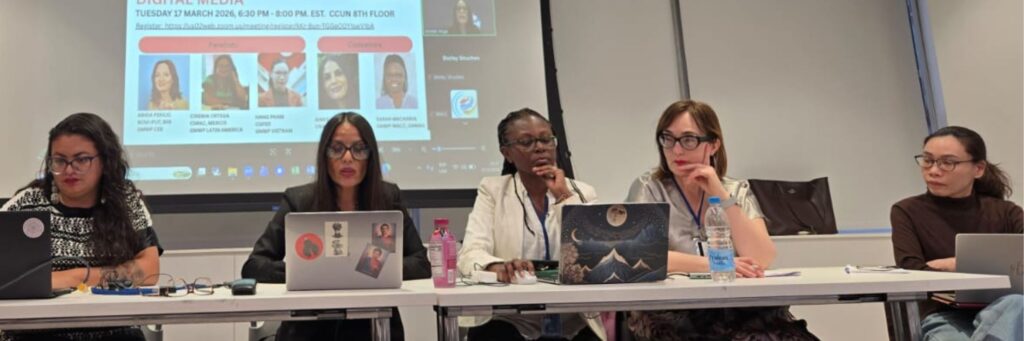
The session “Justice and Ending Gender Violence in Offline and Digital Media,” a parallel event at the NGO CSW70 Forum, was organised by WACC, together with the network of the Global Media Monitoring Project (GMMP) and the Global Alliance on Gender and Media.
Need for change in media and digital sectors
GAMAG chair Aimée Vega Montiel set the stage by unpacking the role of media and digital technologies in eliminating violence against women and ensuring access to justice.
Among the modalities of violence against women and girls, media and digital violence have been recognized as two dimensions that seriously obstruct the fulfillment of women’s human rights and women’s access to justice, she said.
“These sectors reinforce the dynamics that contribute to the structural nature of violence against women. Reproduction of sexist stereotypes, re-victimization, and sensationalism a normalization of discriminatory discourses against women and girls.”
The harsh reality is that content that promotes violence against women “is good business” for media, attracting “hundreds of thousands of consumers,” Vega Montiel noted. The lack of incentive to change has resulted in self-regulatory norms in the media industry that make effective intervention extremely difficult in most cases.
At the same time, activism by feminist scholars, civil society representatives, and journalists themselves has had a positive impact, she said, with the development of media guidelines, codes of ethics, training programs, and advocacy that has brought shifts in policy.
The harsh reality is that content that promotes violence against women is good business for media.
— Aimée Vega Montiel, GAMAG chair
Digital violence has assumed increasingly serious dimensions, according to Vega Montiel. At present, at least 30 types of digital violence against women and girls have been identified.
“Online and offline violence feed each other. The key element that technology adds is the viral character of the distribution,” she noted. “What once was a private matter now can be instantly shared with millions of people across the digital world.”
AI has amplified these harms, making them more scalable, more anonymous, more convincing, and more difficult to detect and redress, according to Vega Montiel.
Gendered disinformation and misinformation have become pervasive, weaponizing technology to damage women’s credibility, public image, and authority. And image-based abuse has emerged as one of the most alarming expressions of AI driving harm.
The fact that this violence doesn’t end in the digital sphere but rather extends into the social sphere with diverse consequences makes it more accurate to speak of “socio-digital violence,” said Vega Montiel.
Impunity is a major challenge to ending both media and digital violence, as is resistance from platforms to adequate public policies, she said. The justice system also lacks a women’s rights approach.
“This is why the elimination of all forms of violence against women and girls in the communication field, needs definitely member states, media and digital corporations to commit in order to make media and digital sector firmly allies of women’s human rights.”
This means more states establishing legal instruments including to monitor media and digital platforms and providing resources to ensure an end to gender violence in media and digital ecosystems. And digital corporations must commit to create effective security protocols to protect women and girls.
Global: Gender-based violence almost absent in the news
The 7th Global Media Monitoring Project, in 2025, collected data on gender-based violence in the news for the first time as a special category rather than under the general topic of crime and violence, GMMP Global Coordinator Sarah Macharia said.
“We wanted to understand the extent to which the news media take gender-based violence seriously. [We saw] that there’s the reality, and there is the news.”
Globally, 1 in 4 females aged 15 and older has been subjected to intimate partner violence, according to the World Health Organization, which reports that sexual violence against children also cuts across geographical, cultural, and economic boundaries.
In the news, however, “less than 2% of articles cover gender-based violence,” Macharia said.
There were similar findings in every region, she added, based on data from almost 100 countries around the world that participated in the GMMP.
“It is clear that this low count is at odds with the serious nature of gender-based violence, which is the most egregious form of human rights violation.”
News media have a professional duty for fair, accurate, and balanced journalism.
— Sarah Macharia, GMMP Global Coordinator
This disconnect has serious consequences, Macharia stressed. “Grossly inadequate coverage hampers consciousness building about the scale of the problem, and unbalanced reporting obstructs awareness about the truth.”
Another major – and concerning – GMMP 2025 finding is how the male voice of authority predominates in coverage of gender-based violence through the choice of expert commentary on the stories. Gender stereotypes are also rife.
The fact is that the news media have a professional duty for fair, accurate, and balanced journalism, Macharia said. “There remains enormous room for improvement.”
Central & Eastern Europe: Media coverage that normalises violence against women
Violence against women is ever-present in Central and Eastern Europe, with an increasing number of femicides and incidents of gender-based violence in general, said Abida Pehlic, GMMP coordinator for the region.
She reported that media coverage tends to stereotype women as passive and men as authoritative, which acts to normalise gender hierarchies and implicitly excuse male violence committed against women.
Victim-blaming narratives that shift responsibility from perpetrator to victim are common in reporting on gender-based violence, as is sensationalism. Women as subjects of gender-based violence often remain invisible.
All this works to “reinforce the idea that violence [against women] is an acceptable, exceptional event, rather than a very serious social problem,” stated Pehlic, who is of president of Association Novi Put, GMMP coordinating organisation located in Bosnia and Herzegovina.
We are losing women from very important spheres of life including media.
— Abida Pehlic, GMMP Central and Eastern Europe coordinator
Pehlic reported that digital harassment and violence is particularly problematic in the western Balkans in the form of misogynist comments, trolling, non-consensual image sharing, and harassment.
“We are losing women from very important spheres of life. We are losing them in media, partially because media are not interested in portraying them but also partially because women are really hesitant to be portrayed in media.”
Latin America: Accountability as foundation for media justice
GMMP 2025 findings in Latin America showed a 6-point decrease in the number of women in news compared to the GMMP in 2020, Cirenia Celestino Ortega, GMMP coordinator for the region, reported.
Based on more than 10,000 news items in the 17 countries monitored, women were portrayed as lacking authority, while men were represented as subjects of power.
Coverage about gender-based violence was only 2% of all news, correlating to global findings. “There’s been a lack of women journalists covering gender-based violence,” she said.
Contextual developments in the region explain much of these results, according to Celestino, who is general coordinator of CIMAC, the GMMP coordinating organisation for Latin America.
She cited the rise in conservative leadership, reinforced gender stereotypes, the dismantling of women’s rights mechanisms including funding for civil society and community media, and increasing violence – online and offline – against women journalists.
We need to start with specific, concrete actions to make digital platforms accountable.
— Cirenia Celestino Ortega, GMMP Latin America coordinator
Media justice means fair representation of women in the news, she stressed, but also justice for women journalists.
In the area of digital violence, Celestino pointed to the example of a regional model law that goes beyond self-regulation by digital corporations by giving tools to states to impose administrative sanctions.
“We need to start with specific, concrete actions to make digital platforms accountable.”
Vietnam: Media and gender-based economic violence
In Vietnam, mining is a major economic force, explained Hang Pham, GMMP coordinator in the country. It is also a sector laden with gender stereotypes, bias, and discrimination.
Knowing that media are pivotal in shaping perceptions, attitudes, and action, the Research Centre for Gender, Family, and Environment in Development (CGFED) with Pham as its director, set out to conduct monitoring and analyse news related to the mining industry from a gender perspective.
The GMMP national coordinating organisation found that women in mining were widely under- and misrepresented.
“Media depicts women in the mining industry as playing only a secondary role or focuses on their physical appearance rather than their professional competence,” Pham said. The industry itself is painted as an inherently masculine one.
Only 15% of people who have a voice in stories about mining are women, she added. One of the rare articles that reported on the achievements of female miners referred to them as the “roses” of the industry.
Only 15% of people who have a voice in news stories about mining are women.
— Hang Pham, GMMP Vietnam coordinator
Recommendations from the monitoring urge media to avoid gender-biased language when recognising miners for their achievements and to diversify both image and narrative content.
Pham stressed the importance of having clear data to be able to advocate for evidence-based changes.
Call to help shape radical new path forward
GMMP 2025 results show that progress has plateaued in the past 15 years despite many different efforts to emphasize that media are central for gender equality, Macharia said in conclusion.
She called on participants and their networks to put on their thinking caps and to send suggestions and recommendations for shaping a radical path forward to gender equality in and through the media.
“What is that path that we have not tread on, what is the path we need? Think wild. Think as boldly and radically as you can. Then share your thoughts with us.”
What is the path forward for gender equality in the media? Email us your thoughts, suggestions, recommendations!
share your
ideas
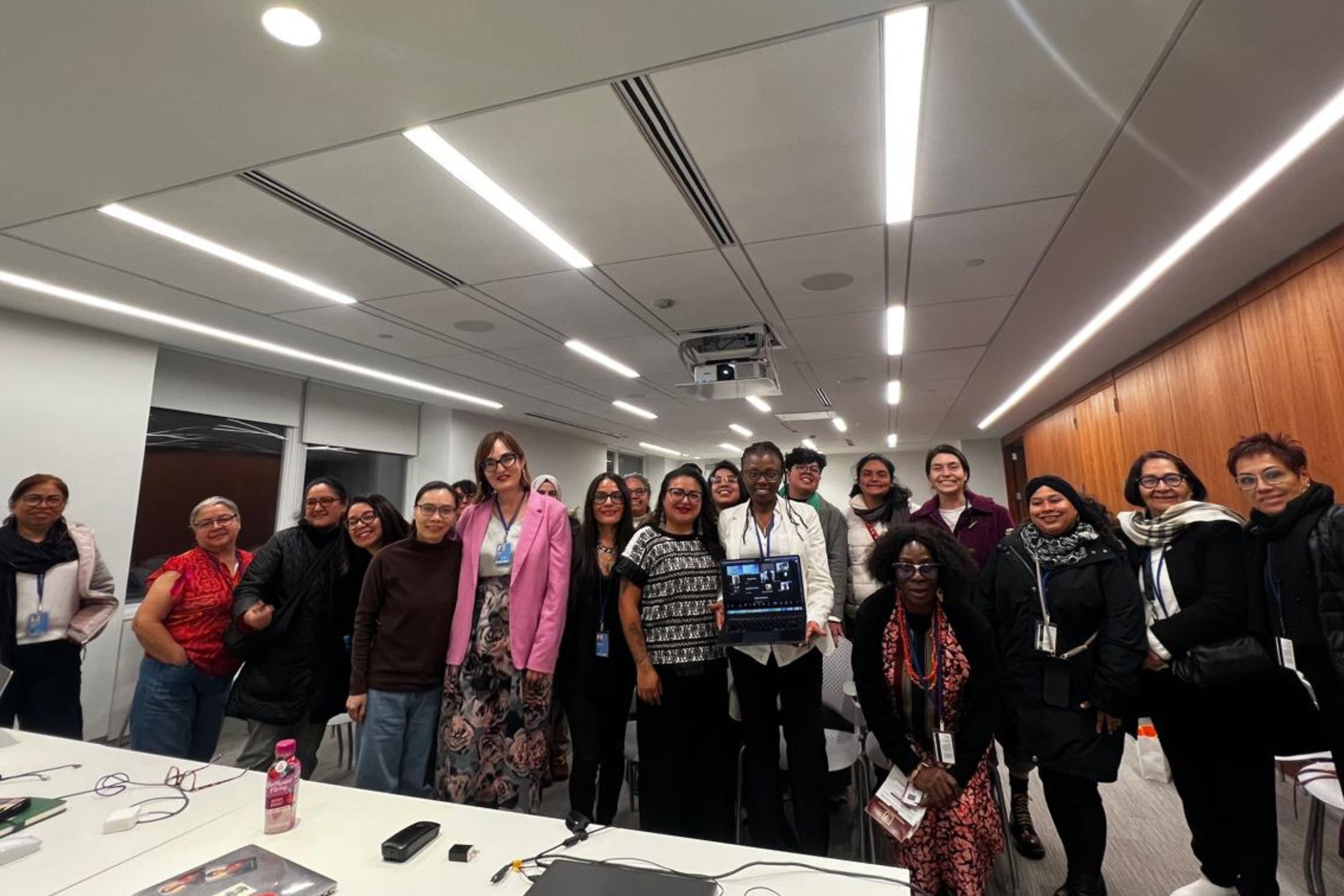
Top image: In-person participants of the WACC–GMMP–GAMAG event on justice and ending gender violence in the media at the NGO CSW70 Forum. Photo: WACC/GAMAG.

 Spanish
  English
Sorry, the comment form is closed at this time.