
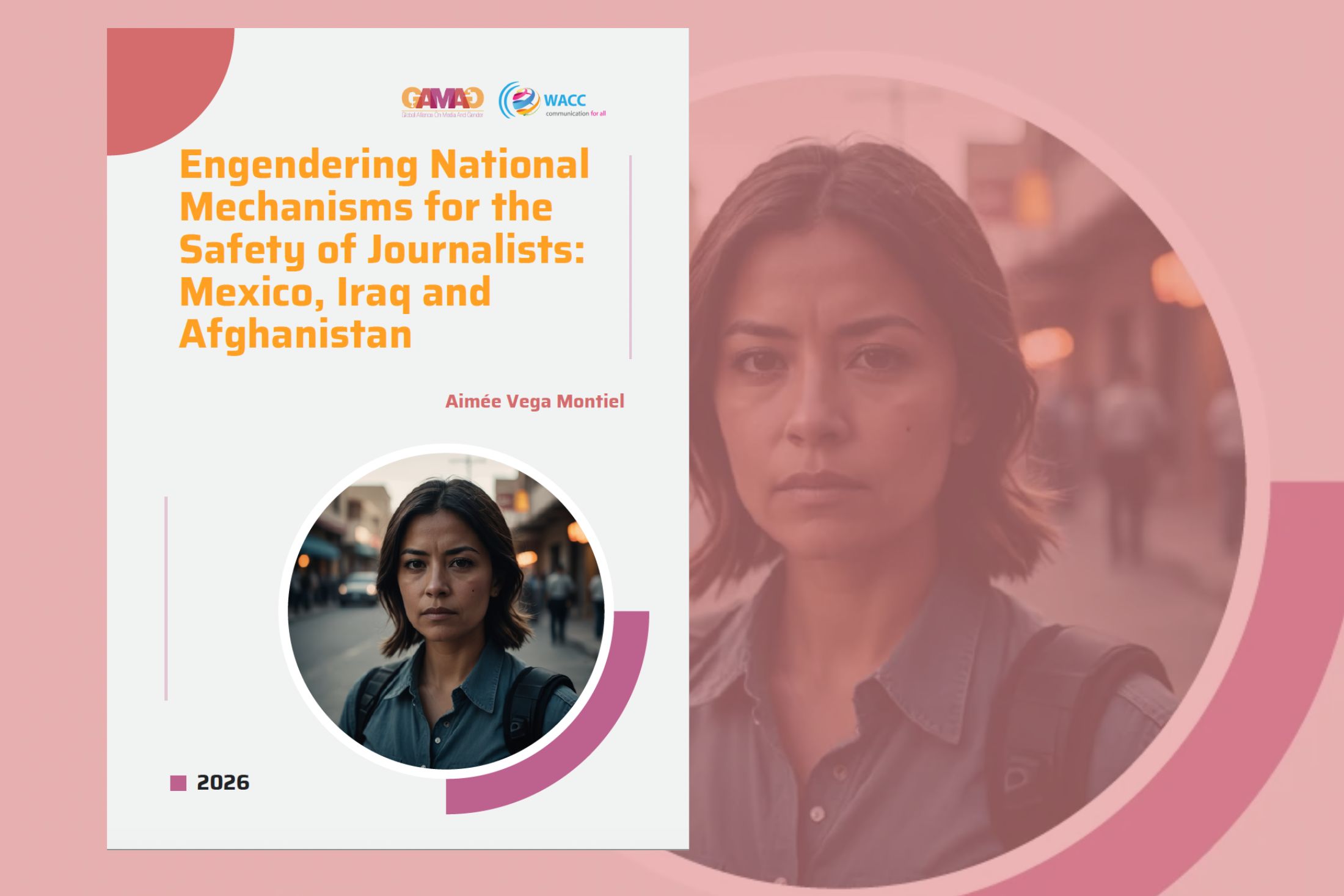
10 Nov Report launched on engendering national mechanisms for the protection of journalists
Lessons from Afghanistan, Iraq, and Mexico
The Global Alliance on Media and Gender (GAMAG) together with WACC Global commemorated the 2026 International Day to End Impunity for Crimes Against Journalists with the joint launch of the research report “Engendering national mechanisms for the protection of journalists in Mexico, Iraq and Afghanistan.”
The research project analyzed institutional mechanisms to address specific conditions and needs faced by women journalists, Dr. Sarah Macharia, WACC Gender and Communication Consultant and GAMAG General Secretary, said in her introduction as moderator.
Implemented in Afghanistan, Iraq, and Mexico, the study assesses the gender responsiveness of the respective national mechanisms and initiatives for the protection of journalists. It also analyzes violence against women journalists including responses to attacks.
Drawing on the lessons learned from the three countries studied, the report proposes recommendations and global indicators to evaluate the gender sensitiveness of such mechanisms.
Key findings from the report were presented by GAMAG Chair Dr. Aimée Vega Montiel, research overall coordinator, report editor, and principal investigator, from Mexico; Lucía Lagunes Huerta, co-investigator from Mexico; and Ruchi Kumar, principal investigator from Afghanistan. Highlights from the Iraq case study were presented on behalf of the principal investigator Basma El Madi.
Mexico
In Mexico, women journalists face psychological, economic, sexual, and physical violence including the risk of femicide. Institutional violence ranks highest among modalities, followed closely by digital violence like doxxing, hate speech, stalking, surveillance, and rape threats.
Established under law in 2012, the Mexican protection mechanism operates three units: Case Reception/Rapid Reaction, Risk Evaluation, and Protection Follow-up/Analysis.
Risk analysis protocols betray gender-blindness and sexist bias, treating threats to women and men reporters identically. Only sexual assault is classified as unique to women while ignoring online violence and family care needs during forced displacement.
In October 2021, the Congress eliminated the dedicated trust fund supporting the mechanism, severely eroding operational capacity. Hostile public statements during daily presidential press briefings have further escalated risk conditions for investigative reporters.
The Mexican government’s recent cancellation of its contract with the private company executing protection measures placed the private data of approximately 2000 protected individuals at risk and has left administrative units unstaffed. The murder of protected journalist Roxanna Guzman is an outcome of this decision.
Iraq
Women journalists face threats from armed groups, political factions, and security forces. While up to 65% experience workplace or field harassment, 98% shy away from reporting threats to police due to state corruption, retaliation fears, and social stigma.
Designated as a pilot country of the UN Plan of Action on the Safety of Journalists and the Issue of Impunity in 2013, Iraq established its National Committee on the Safety of Journalists in 2016 and launched its official operational protection mechanism in 2019.
In 2020, 12 female police officers were assigned to the Special Investigative Unit to facilitate complaint filing by female journalists.
Governance remains heavily male-dominated, with women holding only 3 out of 14 seats on the national committee board at the time of the research.
Afghanistan
A survey of 135 female journalists across 25 provinces prior to August 2021 established a baseline that revealed that less than 10% of journalists experienced physical violence and 5% sexual violence. Approximately 30% indicated having suffered psychological violence in newsrooms.
Over half of survivors of violence did not report incidents due to ineffective mechanisms or career retaliation fears. In one documented case, a female reporter filing a sexual assault complaint against a supervisor was counter-charged with “moral crimes” by local police.
Since the Taliban takeover in September 2021, women have been banned from secondary and university education, forbidden from traveling beyond 70 km without a male guardian (Mahram), and barred from showing their faces or broadcasting their voices on radio/TV in multiple provinces.
Over half of Afghan newsrooms have shut down, and the number of female media staff has dropped by over 80%, from an estimated 2,800 to fewer than 240 active women reporters.
Over 200 Afghan women journalists have fled the country, some establishing exile news outlets like Zan Times, which trains and publishes work by female journalists reporting anonymously from inside Afghanistan.
Expert panel discussion
Albana Shala, UNESCO-International Programme for the Development of Communication (IPDC) Rapporteur, stressed that safety mechanisms cannot provide real protection when state institutions or armed factions are themselves the perpetrators of violence. She called for independent evaluation of mechanisms in conflict zones such as Sudan, Ukraine, and Palestine.
Jennifer Moreau, Vice President of the International Federation of Journalists and national representative of Unifor, Canada’s largest private sector union, underlined that attacks on female journalists constitute direct attacks on public access to information and democratic institutions.
Moreau urged global adoption of a UN International Convention on the Safety of Journalists, international asylum pathways for fleeing media workers, and union collective bargaining clauses to hold employers accountable.
UNESCO-IPDC Deputy Secretary Saorla McCabe presented an account of progress under the UN Plan of Action. She cited recent UNESCO-UN Women research showing that three-quarters of surveyed female journalists reported having suffered online violence, with offline physical spillover more than doubling from 20% in 2020 to 42% in 2025.
Saorla urged civil society and academics to standardize digital violence metrics, push for tech platform accountability, and support early warning networks.
The research was implemented with funding from UNESCO’s International Programme for Development Cooperation (IPDC). “Engendering national mechanisms for the protection of journalists in Mexico, Iraq and Afghanistan” is available in English and Spanish.

 English
 Spanish
Sorry, the comment form is closed at this time.